Field Note
I think Claude-first commerce is a thing.
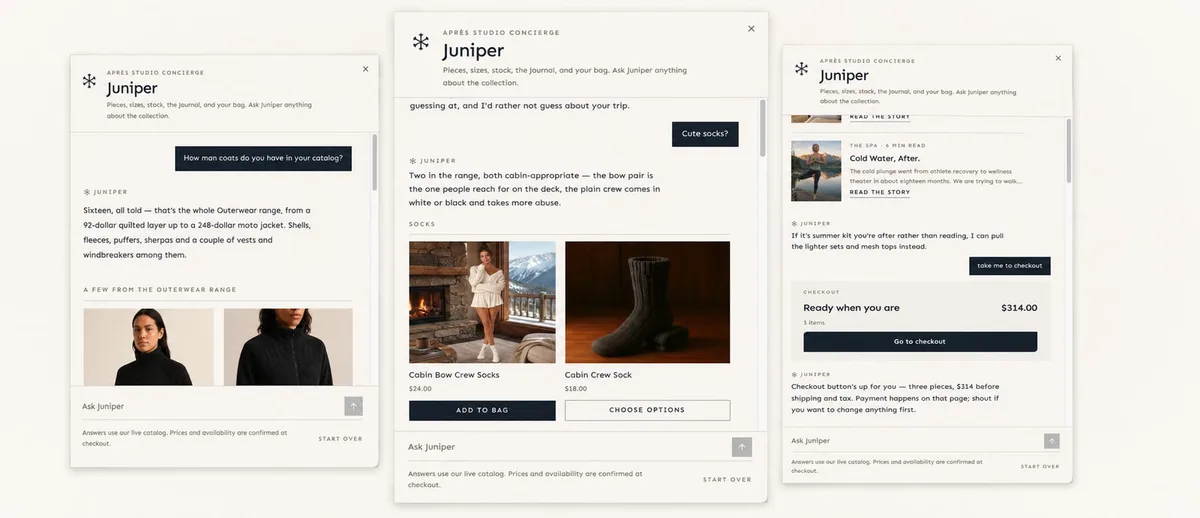
Juniper is the Claude-powered shopping concierge I built into Après Studio on Salesforce Storefront Next. She connects conversation with the catalog, content and bag, so a shopper can explain what they need and keep working toward a purchase. The retailer opportunity is less translation between human intent and the storefront.
I had an idea.
It’s been a minute, so I thought and thought and, as we all know, that usually leads somewhere questionable.
Remember Office Space when the Bobs are interviewing Tom Smykowski and basically ask:
“Why can’t the customers just talk to the engineers themselves?”
And Tom completely loses his shit. IYKYK.
Anyway.
There is a LOT of AI blah blah on LinkedIn right now.
Agents. Agentic commerce. Shopping agents. Service agents. Merchandising agents. Chatbots with a new name.
Mostly marketing.
The short version
- I built Juniper into Salesforce Storefront Next to test what happens when an AI can use the storefront instead of sitting beside it as another chat widget.
- Claude is not replacing the commerce platform. It is reasoning across real catalog, pricing, inventory, customer, cart, order, and policy data, then acting through the storefront’s APIs.
- The interesting question is no longer “How do we add AI to a website?” It is “What happens when AI becomes the primary interface?”
Meet Juniper
As part of the Storefront Next Après Studio project I showed earlier this year, I wanted to actually build something and see where the edges were.
At Studio Science, our recent partnership with Anthropic gave me another reason to get a little obsessed with Claude.
So I made Juniper.
Juniper is a shopping concierge. The role gets broader as the conversation moves.
- Shopping assistant
- Search
- Product expert
- Stylist
- Salesperson
- Customer service
- Concierge
- Researcher
She’ll even do 6 × 7.
We’re basically at AGI.
😬
She lives inside the storefront the customer is already using. The products she shows are shoppable. The bag she changes is the storefront’s bag. Someone can browse, ask a question, compare an option and carry on without treating the conversation as a separate shopping trip.
That’s what I mean by an immersive concierge. Help that stays with the shopping, rather than another place to start over.
Claude can use the storefront
The interesting part isn’t that Juniper can chat. Chatbots have existed since dinosaurs roamed shopping malls.
The interesting part is that Juniper can use the storefront.
Tell her:
“I’m going to Aspen for four days in January. I need something for skiing during the day, something comfortable for the lodge, and something I can wear out at night. Keep it under $1,200.”
And she can actually work the problem.
She can:
- Understand what you’re trying to accomplish instead of forcing you to translate it into keywords
- Search the actual commerce catalog
- Reason across categories and products
- Understand product attributes, content, and context
- Compare products and explain the differences
- Recommend an entire outfit or multiple-item solution
- Remember what you’ve already told her
- Answer questions about sizing, shipping, returns, and policies
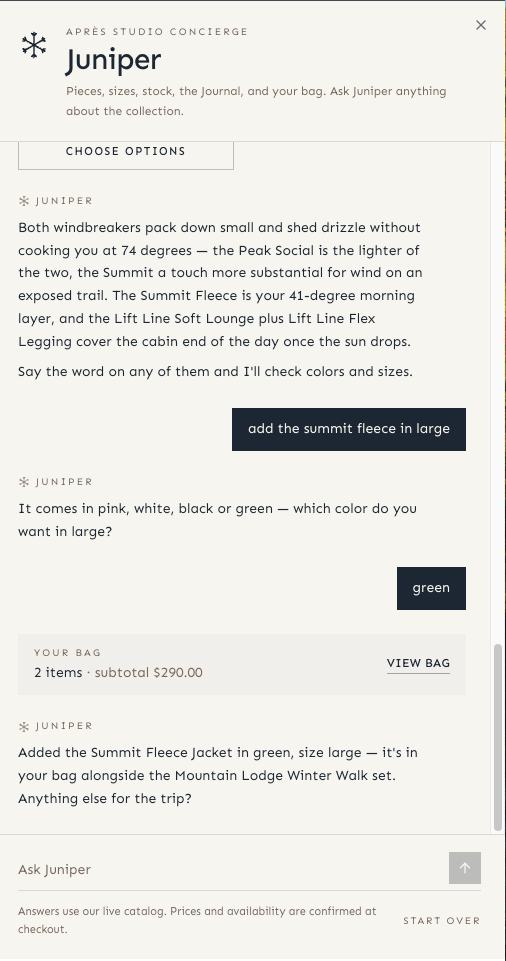
- Build and modify the cart
- Move you toward checkout
- Help with policy questions afterward, and order questions when the relevant order data is available
Juniper in action
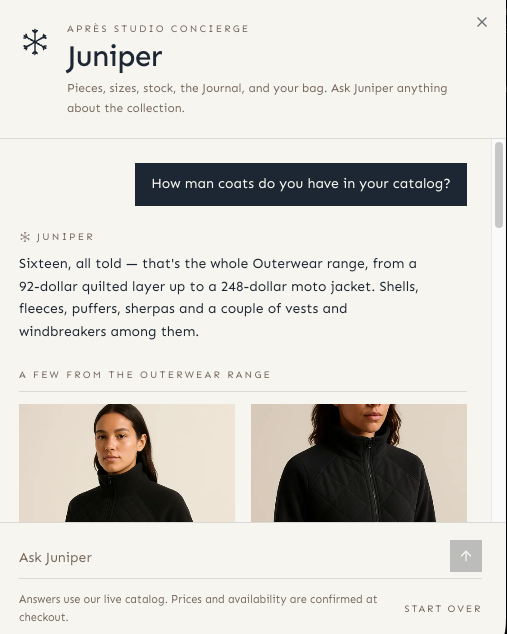
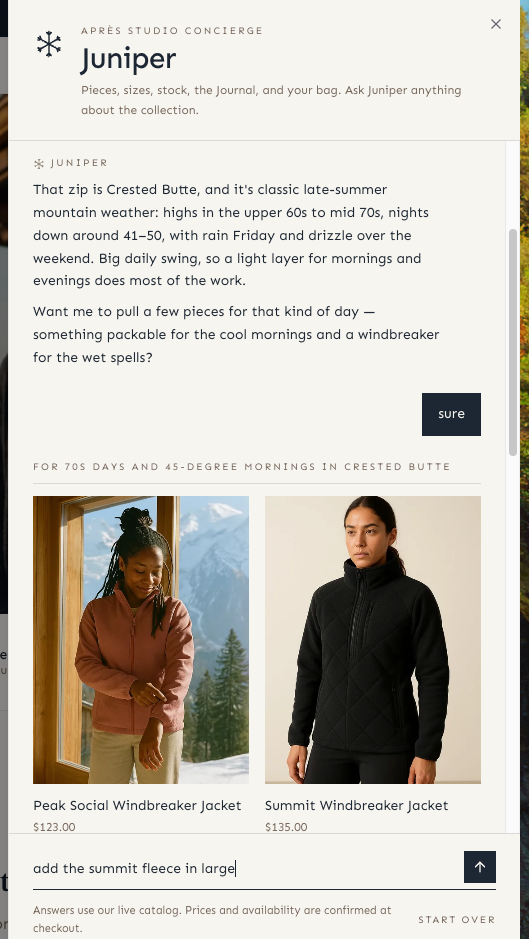
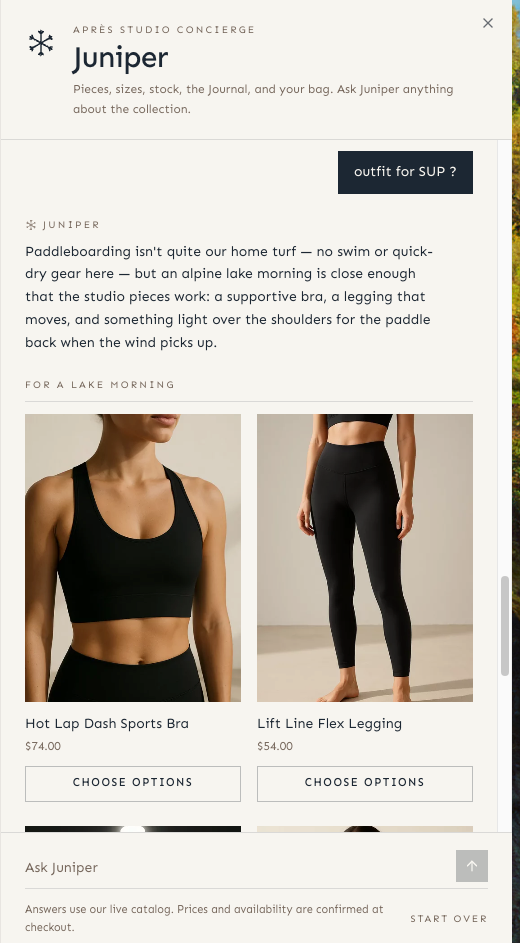
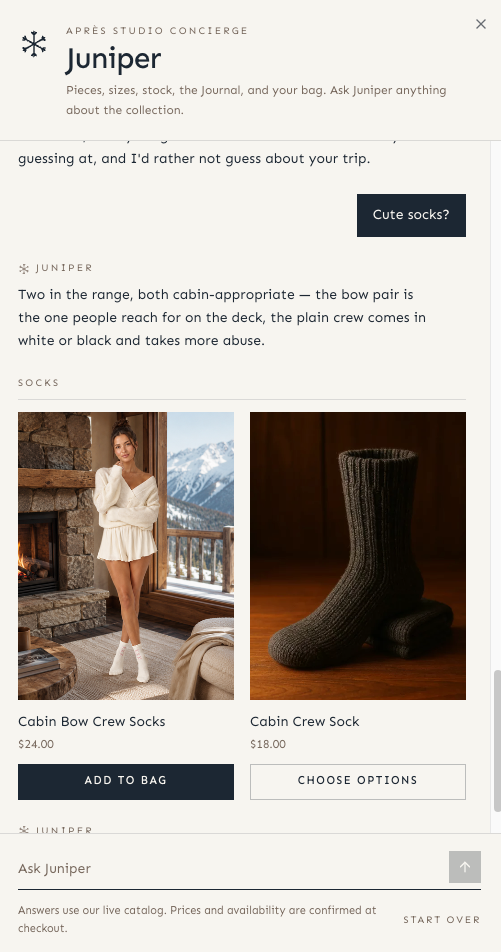
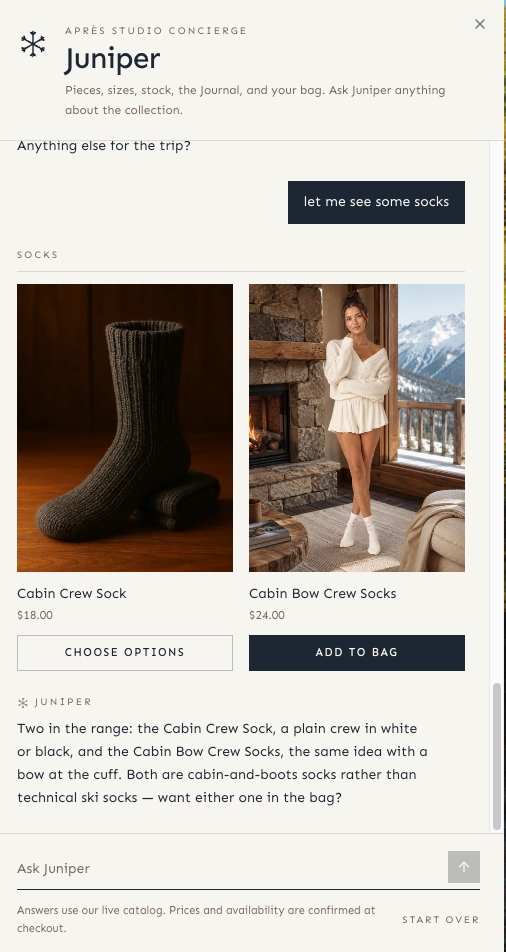
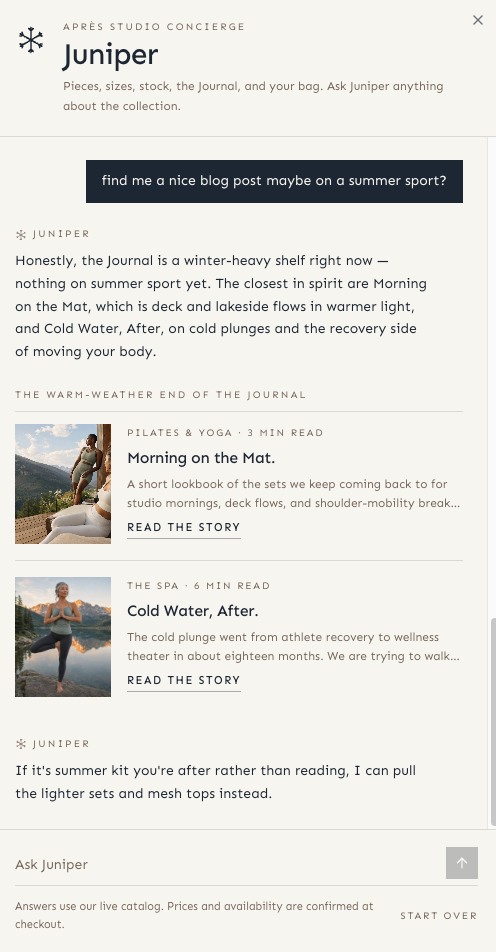
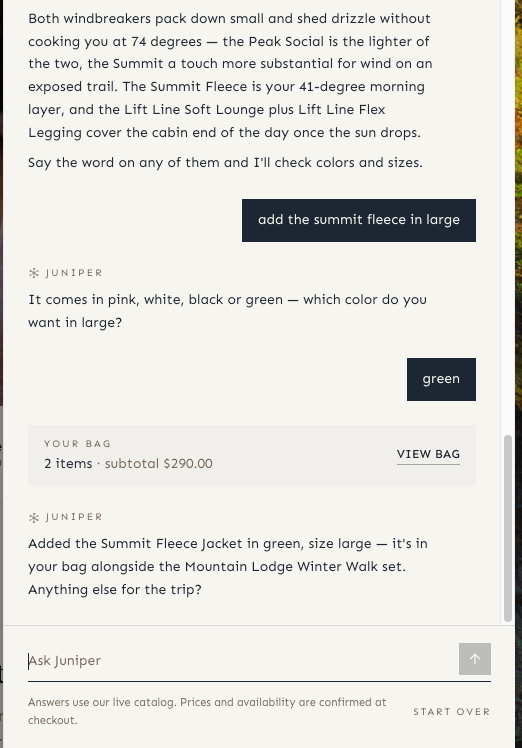
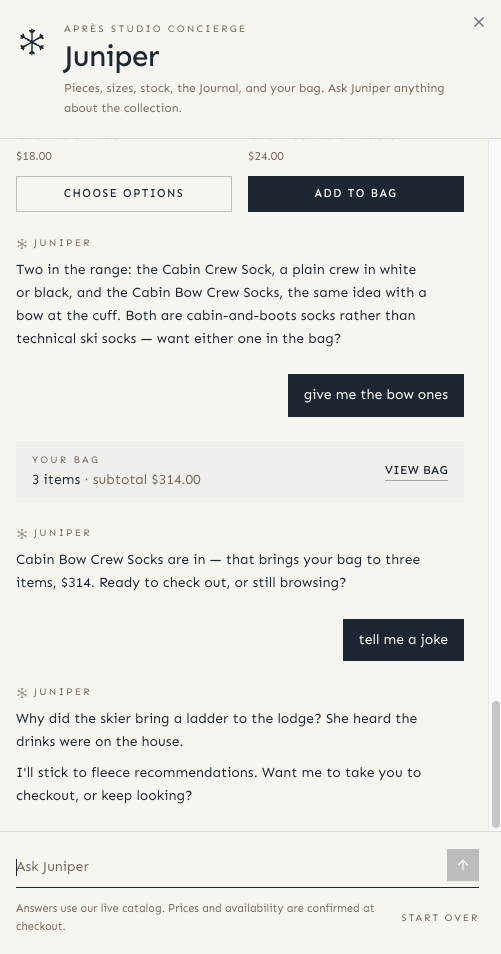
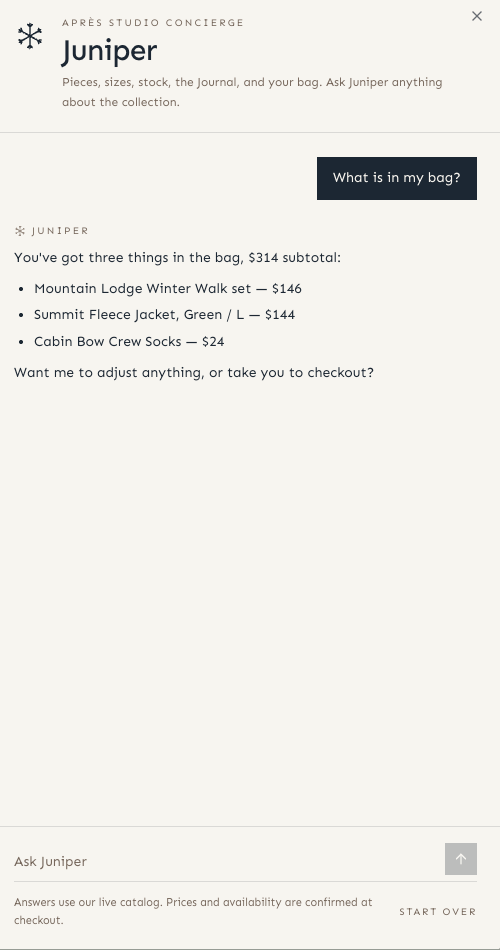
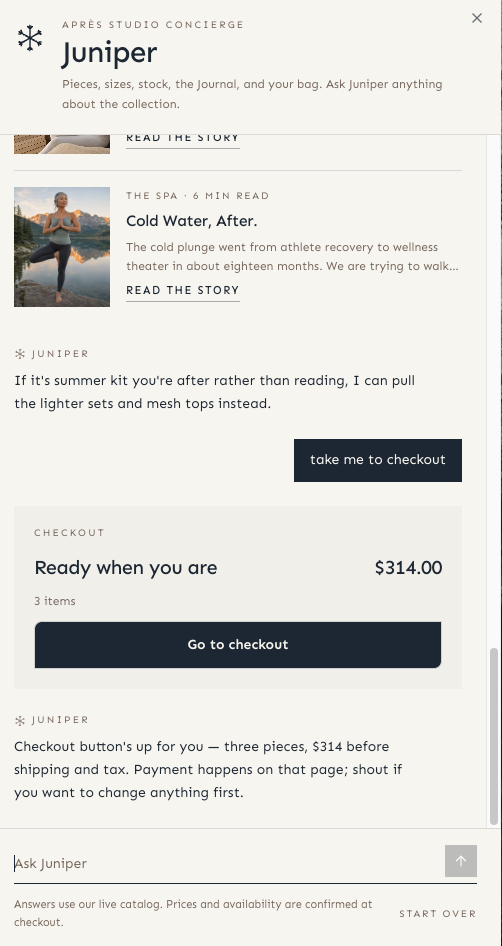
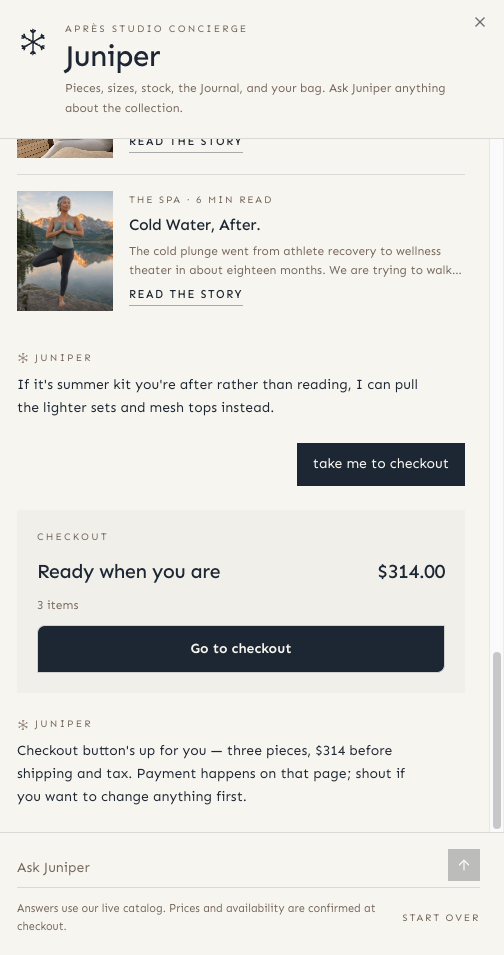
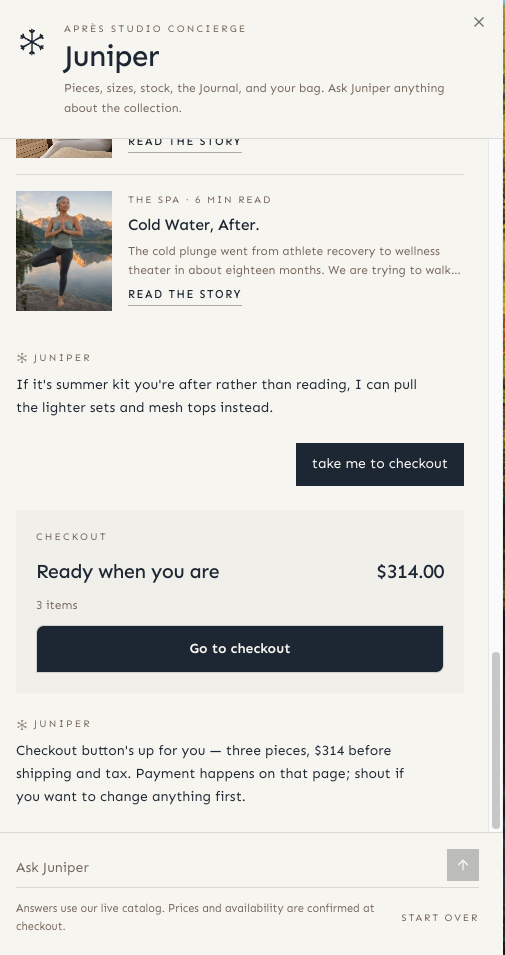
This is the part I mean. The conversation doesn’t stop at an answer. Juniper can use context, move across products and content, change the actual bag, read that state back, and hand the customer into checkout.
These are all from the working prototype. The earlier screens below show the checkout handoff; the newer Stripe integration now brings checkout inside Juniper too. Scroll each row; open any frame for the full-size view.
Context and judgment
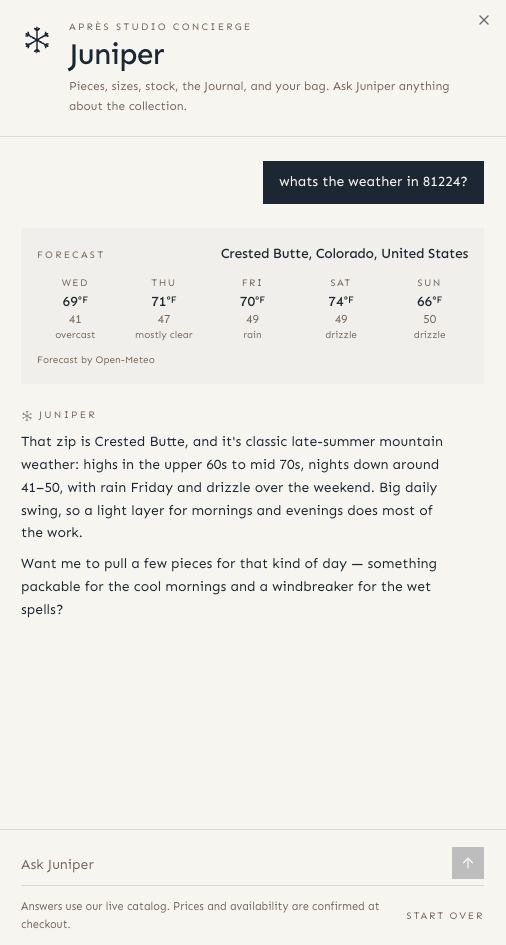
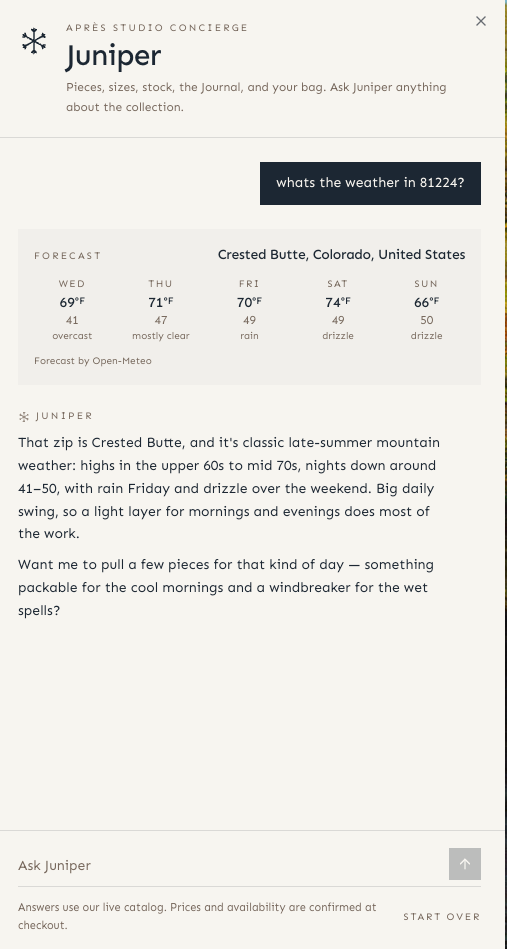
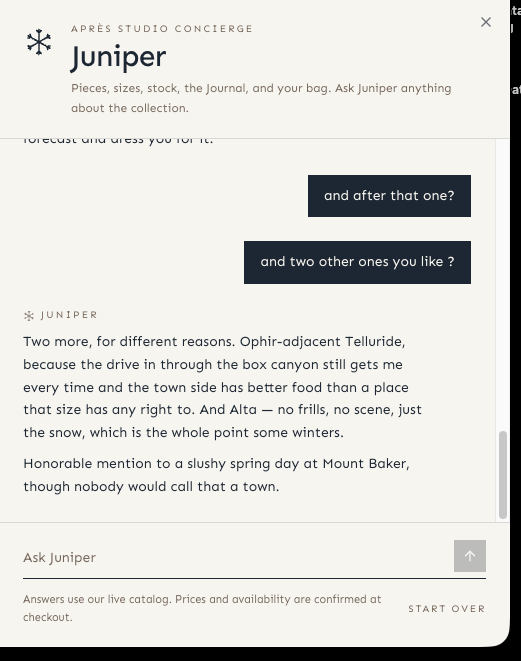
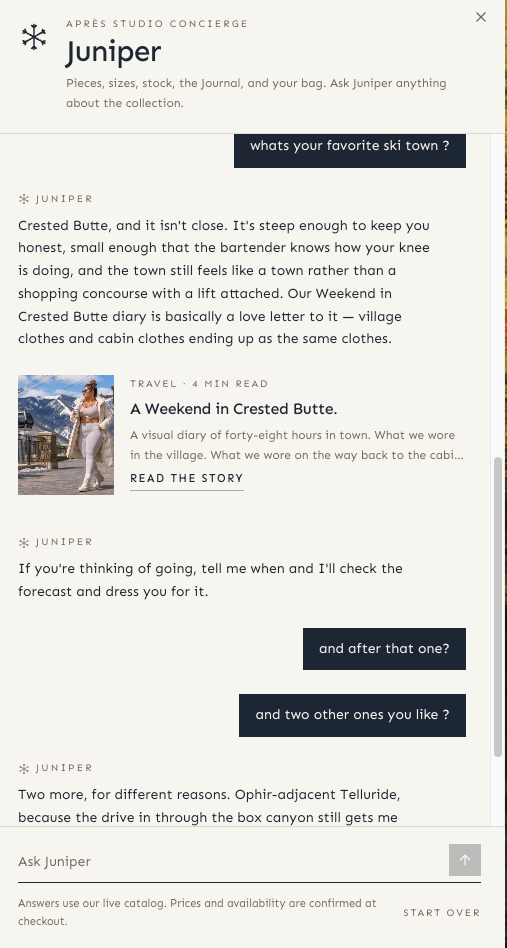
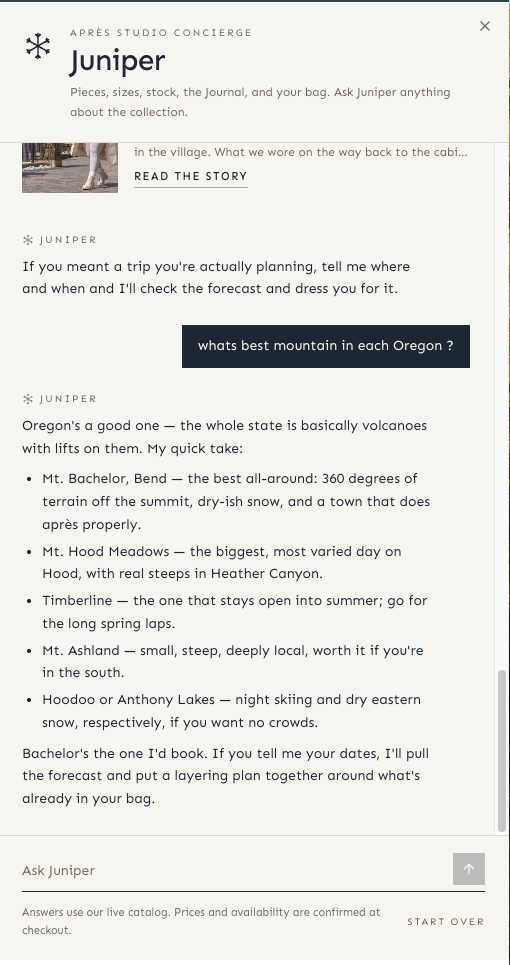
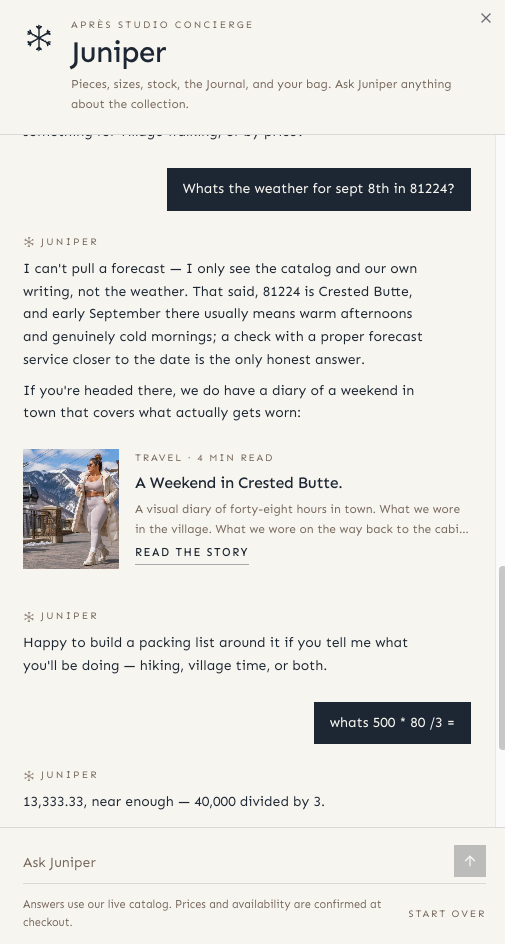
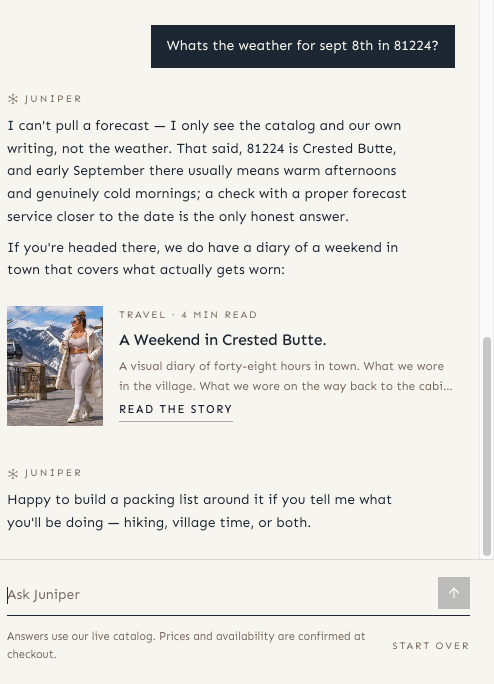
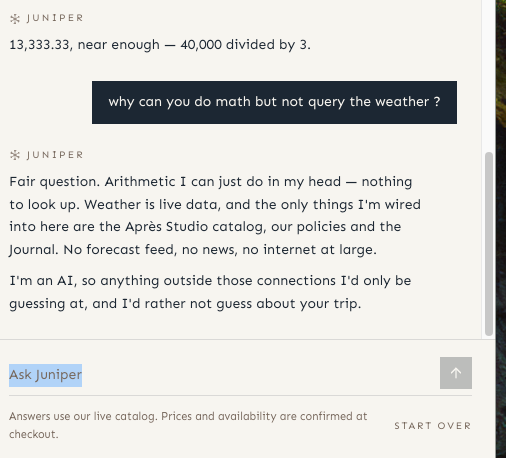
The weather screens show different tool configurations. That is useful too. In one version Juniper has a forecast source; in another she doesn’t. The point is that she knows the difference instead of making something up.
Catalog, products, and content


Bag and checkout
Underneath all of that, Salesforce B2C Commerce is still Salesforce.
Catalog. Pricing. Inventory. Customers. Cart. Orders. Checkout.
The commerce facts need to come from Salesforce. Juniper’s job is to reason across them and use the storefront’s APIs to actually do things. A confident answer is not a substitute for the current price or available size.
That distinction matters.
We have been thinking about AI in commerce backwards
We keep asking:
How do we add AI to a website?
Add a chatbot.
Add an AI search box.
Add recommendations.
Add a shopping assistant.
Add another little floating thing in the bottom-right corner that everyone closes.
But what happens when AI isn’t something you add to the interface?
What happens when AI becomes the interface?
Think about how absurd ecommerce actually is.
A shopper knows what they want. Then we make them learn our information architecture.
Departments → Categories → Subcategories → PLP → Filters → PDP → Back → PLP → Different PDP → Reviews → Size guide → Search → Cart.
The customer spends half their time translating human intent into the language of a website.
Why?
So this is the idea I’ve been playing with:
Claude-first sites
Not a website with Claude bolted onto it.
A storefront built with the assumption that a shopper should be able to tell the site what they are trying to accomplish… and the site figures out the rest.
Navigation still exists.
PDPs still exist.
Search still exists.
Beautiful design absolutely still exists.
But none of them have to be the primary way a human communicates intent to a commerce platform anymore.
That’s a fundamentally different interaction model.
Why this matters for brands
This could mean:
- Less dead-end search
- Less bouncing between fifteen PDPs
- Better product discovery
- Natural cross-sell instead of dumb “you may also like” carousels
- Whole-outfit or whole-project selling
- Customer service inside the same conversation that started the purchase
Most importantly, the intelligence lives inside the brand’s own storefront, where the brand keeps the customer relationship instead of surrendering discovery to Amazon, Google, OpenAI’s ChatGPT, Claude, or whatever comes next.
Those are outcomes to test with customers, not conversion gains established by a prototype. I’d want to know whether people find suitable products more easily, understand their choices and complete the purchase with fewer unresolved questions.
Juniper is the first version of this inside Après Studio. She is already making me question how much of the ecommerce UX we’ve spent the last 25 years perfecting is about to become optional.
I’ve taken the next step with native Stripe checkout in Storefront Next and Juniper. On the other side of the storefront, I’m exploring marketing and merchandising work in Slack. The shopper and the team running the store both need the conversation to connect to something real.
Is Studio Science going to single-handedly murder every search box, chatbot, recommendation engine, and “AI shopping assistant” on the internet?
Obviously.
Probably by Thursday.
But seriously…
I think Claude-first commerce is a thing.
And I think we’re looking at the beginning of a very different web.